

A Faster Caterpillar Is Still a Caterpillar
Companies moved from Microsoft Exchange to O365. From on-premise SharePoint to SharePoint in the cloud. From Word to Google Docs. They called it digital transformation.
It wasn’t. It was substitution. Swapping one tool for another and expecting different results.
Now it’s AI. Companies are swapping ChatGPT into broken workflows, bolting Copilot onto processes nobody has examined in a decade, and telling their boards they’re “transforming.” The budgets are bigger. The stakes are higher. The script is identical.
I’ve consulted with over 100 businesses on automation and AI implementation. The same mistakes show up in almost every engagement, regardless of industry, company size, or how much money they’ve spent. These aren’t random errors. They’re patterns.
In 2017, Stephen J. Andriole, a professor at Villanova University who had served as CTO at multiple organizations and directed a technology office at DARPA, published a piece called “Five Myths About Digital Transformation.” He had spent decades watching companies stumble through technology transitions and distilled the most common mistakes into five myths, each with a corresponding reality.
Nearly a decade later, every one of those myths has resurfaced in the AI conversation. Same patterns. Same blind spots. Same gap between what leaders say and what they do.
The question that kept nagging at me was: why? Why do capable people, running successful companies, keep making the same mistakes every time a new technology wave arrives?
The answer is systemic. Donella Meadows, who wrote Thinking in Systems, argued that a system’s purpose is revealed by its behavior, not by the goals it announces. When you look at how companies actually behave during technology transitions, not what they put in the press release, but what gets funded, staffed, and measured, the patterns become obvious. And predictable.
This paper walks through Andriole’s five myths, updated for AI, and uses systems thinking to explain why they persist. More importantly, it provides a practical framework for breaking the cycle. Because understanding the pattern is only useful if you can do something about it.
The Thesis
AI is not a project you implement. It is not a line item on a roadmap with a start date and a completion date.
AI changes the conditions under which business is done. It changes what your customers expect. It changes what your employees demand. It changes what your competitors are capable of, often before you realize they’ve moved.
The question is not “should we adopt AI?” The environment has already shifted. The question is whether your organization can adapt continuously, or whether it will keep treating each technology wave as a one-time event with a beginning, middle, and end.
Meadows would recognize this immediately. She described systems that survive as ones capable of self-organization, learning, and adaptation. The ones that fail are rigid. They’re built to protect a stable state that no longer exists.
Most companies are still protecting a state that no longer exists.
Myth 1: Every Company Needs an AI Strategy
Reality: Most companies need to fix their foundation before AI can help.
I worked with a major Canadian airline during the early mobile era. The smartphone had arrived, and every business felt the pressure to build an app. They needed an app because everyone needed an app.
The problem was that nobody asked the right first question: what does the customer actually need?
The airline’s underlying systems weren’t ready to provide the information needed to power an app. There was no clear signal about where to start. They ignored the client journey, jumped straight to “we need an app,” and built web apps that performed terribly. No offline capability. Slow. Disconnected from the data systems the app depended on. The functionality was basically useless.
Sound familiar? Today, companies are doing the same thing with AI. They’re swapping ChatGPT into existing broken workflows and calling it transformation.
It isn’t.
Dr. Ruben Puentedura developed a framework called the SAMR model that maps exactly to what I see in the field. The S stands for Substitution, exchanging one tool for another with no functional change. A is Augmentation, adding some functional improvement. M is Modification, redesigning the task because the technology makes it possible. R is Redefinition, doing something that was not even conceivable before.
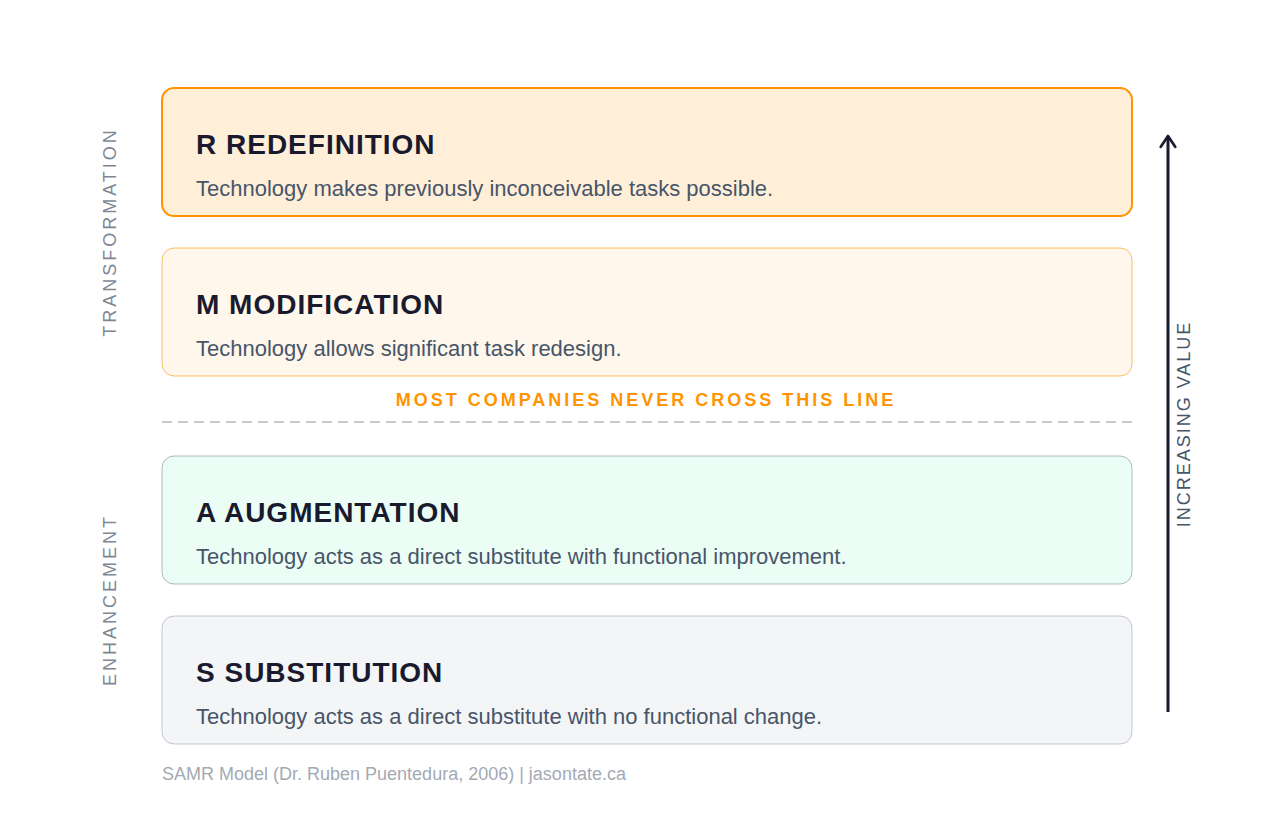
Most companies are stuck at Substitution. At best, they reach Augmentation. That’s where “digital transformation” stopped for the majority of organizations I’ve worked with. AI is following the same pattern.
Andriole made this point in 2017: not every company, process, or business model requires digital transformation. The same applies to AI. Some companies genuinely do not need AI right now. What they need is to fix the systems they already have. Document their processes. Clean up their data. Connect the tools they’re already paying for.
Meadows wrote that you can’t improve a system you can’t describe. If you can’t model your existing processes, if your employees can’t articulate how work actually flows through the organization, adding AI will only magnify the mess.
Even Microsoft is backpedaling on some of their AI-everywhere approach because the discovery is proving out: most of the implementation is performative and delivering little value.
The first honest question is not “what’s our AI strategy?” It’s “can we describe, in detail, how our business actually works right now?”
If the answer is no, start there. The AI can wait.
Myth 2: AI Is the Technology That Changes Everything
Reality: The biggest wins still come from boring, proven technology applied to the right problem.
When companies come to me saying “we need AI,” the vast majority of them could benefit from it. But what they actually need first is algorithmic, systematic ways to solve business problems. More process automation than artificial intelligence.
The irony is that the opportunity for AI after building those systems is massive. But you have to build the foundation first.
Andriole observed the same thing in 2017. He argued that most short-term impact comes from conventional operational technology: networking, databases, enterprise software. Not from the hot new thing. The companies that won were the ones who applied mainstream tools already in consumers’ hands.
Think about Uber. The technology that made Uber possible wasn’t exotic. It was the phone in your pocket, GPS, mobile payments, a well-designed app. All built on infrastructure that already existed. The innovation was in applying proven technology to a business model problem.
AI gets the headlines. But in my experience, the companies that see the fastest return are the ones fixing something boring. Connecting two systems that don’t talk to each other. Removing manual steps from a workflow that hasn’t been updated in a decade. Building a simple process that handles routine decisions so humans can focus on the exceptions.
Meadows would frame it this way: the most powerful place to intervene in a system is often at the level of information flows and delays, not at the level of new components. If information moves slowly through your organization, if decisions take weeks because data lives in seven different spreadsheets that nobody reconciles, adding AI to that mess is like putting a turbocharger on a car with flat tires.
Fix the tires first. Then talk about turbochargers.
Myth 3: Profitable Companies Are Best Positioned for AI
Reality: Comfort is the enemy of adaptation.
Both types of companies come to me equally. The ones in pain and the ones riding high.
The companies in pain are afraid the pain will get worse if they don’t use AI. They worry they’ll become obsolete. They worry the investment will bankrupt them. They worry the implementation won’t work.
The companies riding high have the exact opposite problem. They’re worried it will work. That they’ll have to fundamentally change how they do business.
Both scenarios lead to the same behavior: avoidance. Both types of companies ignore the foundational work. Their data structures, their people structures, their technology structures were built and weathered for a different era. Both are looking for quick, easy solutions. Those solutions don’t exist.
Andriole nailed this in 2017. He argued that profitable companies are actually the least likely to transform successfully because they have the least incentive to change. How many successful companies, without market pressure, have truly rethought their business models? Very few.
Meadows explains this through what she called balancing feedback loops. These are forces within a system that actively resist change because the current state is producing acceptable results. The company is profitable. The shareholders are happy. The processes work well enough. The system whispers: don’t rock the boat.
But “well enough” is a moving target. What was sufficient last year might be inadequate next year. The gap between where your company is and where it needs to be widens every quarter that you wait. Putting your head in the sand because you’re profitable is foolish.
Employees of all ages want to work for digitally mature companies. Companies with the cultural characteristics, the research mechanisms, and the opportunity to experiment. Customers expect experiences that match the best consumer apps they use every day. Partners expect integration that actually works.
If you’re profitable today, that’s great. Use that position of strength to build the muscle for adaptation while you still have the resources.
Because by the time the market forces your hand, the cost of catching up will be ten times what the cost of staying current would have been.
The Transformation Illusion
Before we get to the last two myths, we need to name the trap that makes them so persistent.
George Westerman of MIT captured it perfectly:
“When digital transformation is done right, it’s like a caterpillar turning into a butterfly, but when done wrong, all you have is a really fast caterpillar.”
George Westerman, MIT
A fast caterpillar. That’s what most companies are building. And they’re calling it transformation.
Right now, countless organizations are informing their workforce and stakeholders that they are proud to be “transforming” their business with AI. That they are “leaders in their industry.” The reality for many of them is that they are simply making faster caterpillars.
Westerman and others identified three dangerous downsides to this illusion.
First, companies become so busy creating fast caterpillars that they stand still in the real transformation stakes. They’re heads-down implementing AI widgets and chatbots and copilots, and they can’t see the disruption they’re not preparing for. Their efforts are neither defensive nor offensive in their market.
Second, they devote all their limited time, energy, and resources to faster caterpillars because those “change” initiatives have become the priority. There’s no bandwidth left for actual transformation. The busy work of incremental improvement crowds out the hard work of rethinking how the business operates.
Third, and this is the most dangerous: companies are lulled into a false sense of security. They look at all the AI projects on their roadmap and feel good about themselves. Multiple initiatives in flight. But there’s no vision of a butterfly in sight.
John Hagel III at Deloitte observed that most executives he spoke with were still focused on digital as a way to do the same things, just faster and cheaper. He saw little evidence of leaders stepping back to rethink, at a basic level, what business they were actually in.
That’s Substitution on the SAMR scale. That’s performative transformation. And that’s the script AI is following today, almost perfectly.
A snake sheds its skin and it changes. A caterpillar becomes a butterfly and it transforms. The difference matters. Most leaders are confusing the two.
Myth 4: We Need to Disrupt Our Industry Before Someone Else Does
Reality: Snow melts from the edges.
I disagree with Andriole on this one, at least partially.
He argued that disruption almost never comes from market leaders. It comes from startups making bold bets on old industries. Airbnb. Uber. Netflix. Amazon. The evidence is hard to argue with.
But I’ve seen established companies make bold bets too. Apple. Google. Meta. Salesforce. The difference is where those bets originate.
Often, disruption doesn’t start in the executive suite. It starts with individual employees figuring things out in their silos. Those are the canaries in the coal mine. Those are the signals you should be paying attention to.
In every organization I’ve worked with, there are people on the front lines already experimenting with AI. They’re building their own workflows. They’re finding workarounds. They’re solving problems nobody gave them permission to solve. These people have their finger on the pulse of what’s actually happening. They know where the friction is because they live in it every day.
This is what I mean by “snow melts from the edges.” Real change doesn’t start with executive mandates or company-wide rollouts. It starts with one person solving one problem. That insight spreads. The tools spread. Before long, the organization starts to shift from the bottom up.
Meadows described this as self-organization, the ability of a system’s components to create new structures and patterns without top-down direction. The healthiest systems allow this. They create space for experimentation at the edges. They watch for signals. They amplify what works.
If you spend all your time looking at what competitors are doing, you miss the signals coming from inside your own building. If you want to look externally for opportunities, your industry or vertical is a decent place to start. But the real insights come from exploring the edges in completely different disciplines. How are hospitals thinking about this? How are logistics companies? What’s working in education? The patterns that show up in vastly different organizations are the ones worth paying attention to.
The question for leaders is: do you know what your people are already building? And have you created the conditions for those experiments to surface, or are you suppressing them with policies and fear?
Myth 5: Executives Are Hungry for AI Transformation
Reality: They’re hungry to talk about it.
Andriole was blunt about this in 2017: the number of executives who really want to transform their companies is relatively small. He described a wide gap between what executives say about transformation and what they do.
Nothing has changed.
Today, executives talk about AI in their strategic plans. That talk creates pressure. Subordinates are forced to do something performative, something the executives can point to during quarterly business calls. The result is a lot of motion and very little movement.
This is a systems problem, not a people problem. Meadows identified information flow as one of the most important characteristics of a healthy system. When information moves accurately from the edges to the center, the system adapts. When it doesn’t, the system stagnates or makes bad decisions based on bad data.
In most organizations, the information flow around AI is broken. The signals from frontline employees, the canaries who know what’s actually working, never reach the people making strategy decisions. The system punishes honest feedback and rewards telling leadership what they want to hear.
Executives manage up to shareholders the same way individual contributors manage up to their bosses. Saying the words they think people want to hear. Forgetting their duty to dissent. Forgetting to call out when something doesn’t make sense, because that feels risky. This behavior has been taught and reinforced for years.
Kim Scott, a former Google and Apple executive, gave this problem a name in her 2017 book Radical Candor: Be a Kick-Ass Boss Without Losing Your Humanity. People are afraid of radical candour. And without it, the information that would drive real transformation gets filtered, softened, and sanitized until it’s useless.
External consultants can help tease this out. But ultimately, the work has to be done in partnership with the people inside the organization. If you go to one of the big consulting firms, you’re going to get an 800-page report that tells you all the things you could be doing. That’s nice. But the real power is giving the gift of exploration and experimentation to the people within your organization who can actually implement, not just talk about or theorize on the opportunities.
Meadows argued that the most powerful place to intervene in a system is at the level of its goals. If the real, unstated goal of your AI strategy is “say the right words on the quarterly call,” the system will produce exactly that. Words. Not results.
If you want different behavior, change the goal. Make the goal “build the capacity to adapt” instead of “implement AI.” Make it about the muscle, not the tool.
The Gut Check
Before you read another word about AI strategy, answer these three questions honestly.
One. If you asked one of your junior engineers why this product deserves their nights and weekends, what would they say? How close is that to the actual reason you claim drives your technology strategy? In a technology organization, the gap between the engineers’ answer and your stated purpose reveals whether you’re leading a mission-driven team or just shipping code to improve market value.
Two. Open your Jira board, your roadmap, and your operating expenses. Where, line by line, do excellence in user experience, systems that don’t break, and developer growth actually get funded, staffed, and celebrated? In every digital business, the real priorities show up in what gets sprint capacity, headcount, and budget, not in the “transformation” narrative.
Three. Which specific feature or experience in your product is so remarkable that power users already rave about it in public? If you turned it off tonight, who outside your company would immediately complain, loudly? If you can’t name a loudly-missed capability, you are likely running a solid but invisible product that blends into the noise.
If those questions made you uncomfortable, good. That discomfort is information.
The Path Forward
This section could fill 800 pages. It won’t. Because the companies that succeed don’t follow 800-page playbooks. They follow a sequencing principle.
Remember the airline? We didn’t start with electronic boarding passes. We started with showing the availability of flights because that’s the first step in the customer journey. Then we proved we could handle ticket purchases. Then the boarding pass. Then in-flight entertainment on passengers’ personal devices, which moved us from Augmentation into Modification on the SAMR scale. And now the platform extends well beyond travel into services that customers told us they wanted.
At each phase, we solicited feedback from customers and employees. We talked to the teams responsible for building and maintaining the enterprise systems. We explored why previous initiatives had succeeded. Only then did we proceed. No wasted money. No performative checkboxes.
That’s the principle. It’s journey-based. And it applies to AI just as much as it applied to mobile.
Jakob Nielsen, the usability researcher, documented how organizations mature through predictable stages when adopting any new capability. They move from hostility (“we don’t need this”), through isolated experiments by individual advocates, to dedicated budgets, to managed programs, and eventually to a point where the capability is woven into corporate strategy. His research showed that skipping stages creates fragility. Companies that leap from “we don’t need AI” to “AI everywhere” without building the intermediate capabilities will fail. The same way companies that skipped from hostility toward usability to mandating user-centered design, without building the internal muscle to execute, always failed.
Nielsen estimated this progression could take twenty years for usability. The timeline for AI maturity is compressed because the environment demands it. But the principle holds: you cannot skip the hard parts. You can compress them. You cannot eliminate them.
The Sequence That Works
Step One: Describe your system. Map your actual processes. Not the ones in the documentation nobody has updated since 2019. The real ones. How does work actually flow through your organization? Where does information get stuck? Where do people do the same task twice because two systems don’t talk to each other? You can’t improve what you can’t describe. Meadows was adamant about this. If you skip this step, everything that follows is guessing.
Step Two: Find your canaries. Identify the people in your organization who are already experimenting. The ones using AI tools on their own. The ones who have built workarounds because the official systems don’t work. These people have already done the discovery phase for you. Listen to them.
Step Three: Pick one problem. Not ten. One. Choose the problem with the most friction, the best data, and the highest visibility. Solve it. Measure the before and after; hours saved, errors reduced, and capacity created. Make that win visible to the entire organization.
Step Four: Build the feedback loop. Before you move to the next problem, ask the people who lived through the first one: what worked? What didn’t? What would you do differently? Ask the customers affected. Ask the partners affected. This is where most companies fall apart. They skip the feedback and jump to scaling. Don’t.
Step Five: Sequence the journey. Use the SAMR model as your compass. If you just did a Substitution, ask: what would Augmentation look like for this process? What would Modification look like? At each level, the feedback loop repeats. At each level, the organization builds capability. Not just a new tool.
The goal is not “implement AI.” The goal is continuous adaptation to a constantly changing environment. AI is one part of that. The culture, the information flow, the willingness to listen to the edges, the discipline to sequence instead of leapfrog. These matter more than any specific technology.
Westerman’s caterpillar-to-butterfly distinction is the test at every stage. Did you change something, or did you transform something? If you swapped a tool and the work looks the same, you made a faster caterpillar. If you rethought the work because the technology made something previously impossible now possible, you might be building a butterfly.
The Conversation Starts Here
I’ve watched this pattern repeat; mobile, cloud, digital transformation, and now AI. Same myths. Same mistakes. Same gap between what leaders say and what they do.
The reason the pattern persists is systemic. Organizations are systems. They have feedback loops that resist change, information flows that filter honest signals, and goals that are revealed by behavior, not press releases. Until you address the system, no amount of AI spending will produce transformation. Just faster caterpillars.
The environment has already changed. Your customers know it. Your employees know it. Your competitors know it, even if they’re no better at responding than you are.
The work is not easy. It’s not fast. It won’t fit in a slide deck.
Because it’s hard, it’s worth doing.
I’d love to hear where you think your organization sits in this picture. What myth are you living inside? Where are your canaries, and are you listening to them?
The conversation doesn’t end with this paper. It starts.
References
Andriole, S.J. (2017). “Five Myths About Digital Transformation.” MIT Sloan Management Review.
Hagel III, J. Cited in Llewellyn, R. “Transformation Illusions.” Referenced in MIT Sloan Management Review.
Meadows, D.H. (2008). Thinking in Systems: A Primer. Chelsea Green Publishing.
Nielsen, J. “Corporate Usability Maturity: Stages 1-8.” Nielsen Norman Group.
Puentedura, R. (2006). SAMR Model: Substitution, Augmentation, Modification, Redefinition.
Scott, K. (2017). Radical Candor: Be a Kick-Ass Boss Without Losing Your Humanity. St. Martin’s Press.
Westerman, G. “The Transformation Illusion.” MIT Sloan / Digital Business Transformation.
About the Author
Jason Tate has led international teams at Apple, scaled a technology consultancy to $48 million in revenue, and provided AI adoption consulting for over 100 businesses. He has built multiple post-secondary programs at the Southern Alberta Institute of Technology (SAIT) and Mount Royal University from the ground up, designed courses for Alberta Women Entrepreneurs, Women Entrepreneurs of BC and Alberta Catalyzer, and is currently an Adjunct Professor at SAIT and serving as Entrepreneur in Residence at Platform Calgary.
His philosophy is simple: We solve business problems with technology. We’re not technology in search of a problem.
Contact: jt@jasontate.ca | jasontate.ca
Newsletter: From Signal to Scale (weekly at jasontate.ca/blog)